
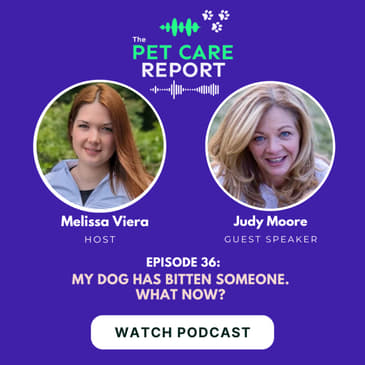

In this episode, our Dog Training host Melissa Viera is joined by guest Judy Moore, a Portland, Maine, resident who has dedicated her life to humane training for difficult dogs. Get ready to learn what to do if your dog bites someone and how to prevent it from happening.
Show Notes:
(00:04:21) Uncover the surprising factors contributing to a dog's likelihood of biting, even days before the incident occurs.
(00:07:12) Learn the most effective strategies for preventing dog bites
(00:09:03) Find out why every dog should be desensitized to a muzzle and how to properly condition them to wear one comfortably.
(00:12:36) Understand the true meaning of a dog's sociability and how it differs from what most people believe.
(00:16:01) Discover how to build a shy or insecure dog's confidence using a gentle, step-by-step approach.
(00:19:45) Recognize the subtle signs that indicate a dog is uncomfortable
(00:23:14) Witness the rewarding process of helping a fearful dog gain confidence and trust through incremental training.
(00:26:03) Learn the importance of a detailed bite risk assessment and how it can help you understand why your dog bit someone.
(00:29:15) Find out where to access valuable resources and information to help you navigate a challenging dog bite situation.
Follow Judy Moore
https://caninebehaviorcounseling.com/
https://www.facebook.com/CaninebehaviorcounselingLLC/
https://www.instagram.com/dogs_judymoore/
https://www.youtube.com/user/JudyAMooreCBCLLC/videos
Follow our Host, Melissa Viera, at https://mjspettrainingacademy.com
Want to see more from Pet Summits?
Subscribe to the PetSummits YouTube channel here: https://www.youtube.com/@PetSummits
Check out the latest free events here: https://petsummits.com/events/
[00:00:00] The Pet Care Report The Pet Care Report Hello and welcome back to The Pet Care Report. I'm excited for today's episode on Pet Care Report. I'm excited for today's episode on a very important topic and I have just the guest joining
[00:00:55] me to cover this topic. In this episode, we're going to talk about the pet care report. Today's guest is Judy Moore. Judy is a resident of Portland, Maine and she has dedicated her life to humane training specifically for difficult dogs. When Judy rescued three dogs of her
[00:01:16] own that were challenging, she found out that she had an illness and that she had to go to the vet to get a new one. She was very worried about her health and she
[00:01:29] had to go to the vet to get a new one. She was very worried about her health and she had to go to the vet to get a new one. When Judy rescued three dogs of her own that
[00:01:41] were challenging, she found out that she had an interest in being able to help these dogs and they went on to achieve their canine good citizen. Judy is a member of the Association of Pet Dog Trainers and she also has a whole list of credentials
[00:01:57] that are available to help them with their pet history, they might have some aggression. So Judy is just a person to guide us through this difficult topic. Thank you so much for being here. I'm really excited to cover this topic. I think it's really important
[00:02:09] for our listeners to hear this information. So thank you and could you start out by telling us a little bit about your three dogs that you started becoming interested in behavior with? Absolutely. Thanks Melissa. It's great to be here with you. Yes,
[00:02:26] I started out as a very new dog trainer with three territorial dogs, all with bite histories. And I needed support for them. I needed to figure out how was I going to help these dogs? So I started joining the APDT. I started meeting with lots of
[00:02:41] different trainers, went on lots of different platforms and I was fortunate in that the guidance that I had right from the get go back in 2000 when I had the first when I adopted her and she put three holes in a few different men. And I was very
[00:02:56] fortunate to find positive trainers so I didn't go down that path as a correction trainer. And I think that's why my dogs did so well. I was able to utilize the information from people like Cathy Sadeo and Ian Dunbar and Suzanne Clo there
[00:03:09] and lots of different trainers who were able to guide me into using a positive approach to counter condition these three dogs and they all did very well. And I was reading your philosophy
[00:03:17] on your website and it's just so well written because you do go into those details about exactly what those methods are. And you have the list of all the amazing trainers and researchers who helped develop these positive methods. So can you tell us a little
[00:03:33] bit about what that means to rely on positive methods or force free methods? Yes, I think the two big things that I believe in the holistic approach looking at the whole animal and using reward based training. In my experience when I'm working with dogs who have
[00:03:50] bitten most of these dogs are misunderstood. While a dog can bite out of confidence we know that somewhere in this dog's path it has poor sociability with people right? So the resource guard for example, I've done a lot of resource guarding and people want to correct that behavior
[00:04:06] but the truth is a dog that guards resources actually has low sociability with people and they use resource guarding to become that bully. And we know this from working with people. So I love going down the positive approach and the goal for me is watching that relationship rekindle
[00:04:22] with a person who says oh you can help my dog. I said I can help you to help your dog. Once we understand an animal's sociability and their social preferences things can fall into place
[00:04:33] rather quickly and I think that's really great to be able to give to clients because I was incredibly stressed when I had three dogs with all three with bite histories and I was thankful
[00:04:41] that there were positive trainers out there who were able to give me the guidance. So now I'm after you know almost 30 years later I'm wanting to share that information with others.
[00:04:51] Yeah and I like that you put it that way because it's not just about helping the dogs. I mean the owners are incredibly stressed at that point. It's a very hard thing to navigate and to feel
[00:05:01] like they have to do that alone or to try to do that without guidance by just like reading things online can be very dangerous for sure with such a serious challenge. Agree people can go down the wrong path and you can make your dog worse.
[00:05:14] Yeah now what would you say to do? We're going to talk about how to prevent bites but before we even get into that if somebody has a dog that has bitten themselves or somebody else
[00:05:27] in the household or anyone at all or even another dog what would you say is the very first step they should take? That's a great question. When a bite occurs we feel terrible first of all owning
[00:05:38] a dog who bites somebody or another dog we feel terrible but the first thing we want to do is take a breath and remove that dog to a place of safety. We want to make sure that that dog's
[00:05:47] not put in a situation it's not good to just pull him aside knock it off and let him you know try to go back into that setting so put the dog away for safety and then check on
[00:05:57] the other person of a dog. Do they need medical help? What are the needs of the person who has been bit? That person obviously is having some physical pain as well as some emotional pain
[00:06:07] and I think it's really important after we take care of our dog and the person or dog that's being bit that we look at who was present. Was there an unfamiliar person or an unfamiliar
[00:06:17] dog or did the dog bite a familiar person and if I have a dog that bites a familiar person I'm certainly going to look at the relationship between those two. We want to think about what was the setting? Was it
[00:06:27] a nice quiet setting which is the owner's home or was it in a busy social setting we're going to have a lot of holidays coming up and do we really want to be putting a dog with low sociability in a
[00:06:37] social setting? You know when we think about maybe a dog was in daycare maybe he was at the dog park and either bit another person or dog if those are very stimulating environments that's something
[00:06:47] that we want to know. I think it's important also to know when exactly did the bite occur? Did somebody walk in the front door? Did somebody grab that dog's collar? Did someone walk by the dog's food bowl? We want to know exactly
[00:07:02] when that bite occurred. Was the dog laying with you on the couch and somebody approached the dog jumped off and bit them. Knowing the specifics is really important so we've got is there somebody familiar? We've got what was the setting like?
[00:07:17] When did this happen? Where did the person bite? Where did the dog bite the other dog or other person? If a dog bites a dog in a leg that's not as severe as if it goes for
[00:07:27] the face and neck. Same thing for a person. If you've got a dog that's biting somebody on the back of the neck. You want to know if that dog is going to jump up and grab a forearm.
[00:07:37] Then of course how bad is that bite? As you're taking this information you want to know all of these intricate pieces of information because when we think of being Dunbar's bite scale we know that level one which is no contact is really just a
[00:07:52] threat display that that dog is trying to get that stimuli to go away is very different than a level four bite. A level four of two to four punctures with severe bruising. That dog's got a pretty hard mouth. Taking in first, taking care of your dog
[00:08:07] the other animal or person and then really taking note of all the different pieces that were in that setting because it's all going to come into play. Yeah and when you say taking note it sounds like
[00:08:17] literally writing it down because I mean that person could be very much in shock at that point so writing it down and taking those notes. It sounds like a lot of information to try to remember but just sounds like writing it down is a good idea.
[00:08:32] It is. Each piece of it will tell us a little something about that dog. Now what about even leading up to the bite? So these are circumstances that maybe the dog was in daycare when it happened or
[00:08:42] at a park. What about even the days leading up to the bite? Do you see a lot of cases where a dog is in a different situation or they're just overstimulated leading up to an incident as well? I do. I think it's really important to know
[00:08:57] what led up to that. I've had dogs who have bitten kids a few different times the evening that they got home from daycare and so they haven't recovered and I think when dogs do come out of a highly stimulating environment, I think the question is
[00:09:12] how high does that dog go in its arousal? How high does that dog go? Does that dog go his arousal so high that he's not in his thinking learning brain and then how long
[00:09:22] does it take for that dog to come back down from that specific setting such that it can respond in a thoughtful brain. And am I meaning about thoughtful is in that dog can walk with good flexion. He's licking his lips. He's blinking. How long does it take
[00:09:37] for that dog's arousal to come down? Because you're right. And I think like humans too, right? We come home from work and we're like, I've had a bad day. Leave me alone. Right. Yeah. So being able to make sure they have
[00:09:47] that time to relax and recover is really important. And so many dogs are in daycare so often too. So it's really something to think about if they do well and they enjoy it, still making sure they have
[00:10:02] that time to themselves. Because even if they get a nap time at daycare, that is very different than a nap time at home on the sofa where they really can shut down. Agreed. Agreed. And I think
[00:10:12] for some dogs that are in that kind of highly aroused, highly energetic and they run around and they are having a good time at daycare, but they quickly respond to different dogs that
[00:10:22] mal them. They go home and then a child just reaches out and pets them and they might whip their head around and say, oh yeah, it's just you. Sorry, I had to do that too many times today. I had too many dogs
[00:10:32] chasing me and mouthing me. Right. Yeah. That's a really good point. They can become kind of reactive to wait what's touching me. And so we need to help them come down and get them back
[00:10:42] in their, help them center and breathe again, right? Right. Yeah. It's kind of like that context switching of going from computer work to doing something totally different. Right. So you really have to turn your mind into a whole different mindset. So it's the same with dogs as well.
[00:10:56] Correct. Very, very true. Very similar. Now what would you say is something that people can do to actually prevent bite? So this is, it's really difficult if a bite has happened and they're going to take down those notes. That's the first step.
[00:11:11] We're going to circle back to getting the professional help that they need once they have those notes. But what about preventing bites from happening in the first place? What can be done? Yeah, I think effective strategies for dogs who think
[00:11:26] their dog might bite. I think the first thing that comes to me is management. So if I have a dog who's maybe growled at people, was a chase people, management is
[00:11:36] a good way to prevent a bite. Now it's not the only way because management fails. I'm a professional and my management has failed. But management is about creating settings where the dog
[00:11:46] is less likely to bite somebody. For example, if you have your dog who charges the front door and you're really not really liking the way your dog's treating people, a lot of barking and backing away,
[00:11:56] putting up a gate so somebody can step in the home but the dog can't get to them because that's a very arousing situation when an unfamiliar person walks in and the dog's charging the door.
[00:12:06] That is a common place where dog bites happen. So adding a gate so the dog can't get to the person. If you're out in public, adding a nice little dog collar that says do not pet. And
[00:12:16] that can keep dogs who really are not very tolerant of tactile touching, that can keep people to keep their hands to themselves. I think that's a good idea. There's also a vest that you can put on. Now a vest might just say dog needs space. I'm not advocating
[00:12:31] that you take a really shy dog with low social confidence who goes around the world like this into a social setting with a vest on. That's not what I'm saying. But I am saying
[00:12:41] if you need to take your dog to the vet somewhere or if you need to go from point A to point B, that vest can keep people at a distance if your dog needs that extra space. I also think it's great to desensitize your dog to a muzzle.
[00:12:55] Every dog should be desensitized to a muzzle. It's not just dogs who might bite. We find that if the dog is in pain. We've had many good dogs that snapped at people because somebody has rubbed their right ear and they had an ear infection. So having
[00:13:10] dogs be desensitized to that muzzle so that they can get the veterinary care they need without the stress of putting the thing on their face would be something really helpful.
[00:13:20] If you have seen your dog, maybe the groomer says your dog's growled or maybe your neighbor said, hey, your dog just growled at me or your dog just nipped. Those are all cautionary signs and you need to say, hmm, should I have
[00:13:30] my dog in that room when that person comes over to visit? Maybe I want to manage and just put my dog in the bedroom with a nice kong so that my dog is not stressed in that setting.
[00:13:40] I really like the muzzle topic. Can you tell us what type of muzzle and what the first steps are for starting the muzzle conditioning? Right. So muzzle conditioning is about creating a positive association to that muzzle. And there are different muzzles out there. I tend to
[00:13:55] use, there's a leather muzzle and I'm probably going to forget the name of it right now, but what I like about the muzzle is I can still feed treats through the front. I want to make sure that when it comes up
[00:14:05] here that it's not, that the type of muzzle lays on top of the nose at a really nice space. We don't want it touching the black of the nose here where it's going to be bending in
[00:14:15] and affect the breathing. And we also don't want it up too high into the eyes. So making sure a muzzle fits a dog really well is a big part. So you want a muzzle that has multiple straps that can, are good for adjusting.
[00:14:30] And I also think that you want to take your time when you're muzzle desensitizing. You can hold out that muzzle, put some treats in it, let the dog eat it, let the muzzle sit in the dog food bowl
[00:14:40] and let the dog eat in there. You really want, when you show that muzzle to your dog, you want your dog to run over to it and say, hey, I like that. That predicts good things.
[00:14:49] And making sure that you get one that fits your dog really well is important. The fit is important because if it's just bouncing around and it's too big, and that's what I think I would say the most often is I see
[00:14:58] muzzles that are too big and they're creating chafing on the top of the nose. So with the muzzle training, do you find that, you said all dogs of course, and I agree with that, all dogs should be muzzle trained. Do you find that a lot of people
[00:15:12] wait until they need the muzzle before they start to use it or train it rather? I think that's very true. I think a lot of people wait too long. And it's really not a bad thing. It really is something that we can condition our dogs to.
[00:15:27] We never know when our dogs are going to get sick and need to go to the vet's. And let's face it, good dogs can become very less tolerant of handling when they're uncomfortable and they might snap.
[00:15:37] You might have that dog whose social confidence is low and he's never going to snap and he's just going to tolerate. But a lot of us have dogs who become activated and push back a little bit, say stop it.
[00:15:47] Not a bad dog. It just means that when he's uncomfortable and maybe he has low pain tolerance, he's more likely to snap back. I think one of the muzzles that I've used in the past that fit a lot of the large breeds is the Baskerville muzzle.
[00:16:02] And that one seems to fit because I can adjust the side piece here and that usually works really well. But again, I want to be able to feed food. This is really important for muzzles. I want to make sure their mouth can be open so they can pant.
[00:16:17] I don't want to be taking a dog for a walk in a muzzle that maybe a vet would use that completely encompasses the nose That's not recommended. That's great information.
[00:16:27] So when someone starts to see some of these signs, they're noticing maybe their dog is becoming a little anxious when people walk in the home as you mentioned. That's a really common area for bites to happen.
[00:16:37] Or they're just starting to see things that could potentially lead up to a bite that you've mentioned. What should they do for addressing that? How soon should they seek out training and help?
[00:16:52] I think there's two things that go along here. If you're seeing signs that your dog has poor sociability and what does that look like? Sociability is a highly social dog. It's that dog who approaches in a relaxed spine with a nice fluid footfall,
[00:17:07] makes gentle contact, gentle physical contact, and looks somebody right in the eye. It's that dog who says, hey, I want to engage with you as a human. I don't know you, but I like people. I believe truly in our world that most people say my dog is social
[00:17:22] and I have to say, is he social? Did he really go up, make gentle physical contact, make gentle eye contact, and solicit touching? What I find often is dogs will approach, they'll smell me thoroughly, and then they disconnect.
[00:17:37] It's nothing to do with me. They're meeting their own olfactory needs because they want to come up and smell. Do they have the social confidence to come into my space? Yes, but I think a lot of times people just say, well, my dog approaches people, therefore he's social.
[00:17:52] I think helping people understand is your dog really social and what if somebody reaches out to pet him and he ducks his head away, why is he moving his head away? If they're finding that their dog is not the most social,
[00:18:08] what can they do to help that dog? The idea is not to change who the dog is, but to make them feel more comfortable and to put them in safe situations. What are some tips for that? Great question. For me, it really comes down to
[00:18:23] what is that dog's sociability? We all know we're not going to change a dog's sociability. We can change his social confidence, but we're not going to change his sociability. If you have a dog that avoids people in all settings all the time, that dog's telling you,
[00:18:38] I'm not interested in making friends. I'm really happy just being your support dog. We do not want to go out and try to socialize that dog. Do we want to build his confidence if he's insecure? Yes, we do. But I think the sociability and
[00:18:53] understanding what that is, is really important, as well as how tolerant is your dog? Meaning if your dog does approach somebody and somebody reaches out and petted, what is your dog's tolerance for petting? If your dog moves its head away or moves its body away,
[00:19:08] or maybe as a puppy, your puppy was really malby. Whenever you'd petted it, it would reach your mouth around it, it would malve your hand and say, hey, stop it.
[00:19:19] I've got other things to do. So I think helping people understand, yes, I want to socialize my new dog. But then we have to say, is it socializing the dog to like everybody? No. Do we want to build the dog's confidence with one person at a time? Yes.
[00:19:34] So I recommend if somebody has a dog who's a little shy or insecure and also lacks confidence to approach people, we don't want to put that dog in a social setting. That dog's worried about one person.
[00:19:44] It would not be fair to take that dog in a social setting. That's where we start in a familiar setting with one person at a time. And I'm a fan of Suzanne Clother's Treat and Retreat,
[00:19:54] where the person stays still and the dog gets a choice to go up. It's not we're not luring it. We're not luring a fearful dog. But the person walks up and says, hey, how comfortable are you coming?
[00:20:04] If the dog stops six feet away, then that's where we would start and toss that treat. We're giving the dog a choice. And then all of a sudden we're like, oh, you're only comfortable approaching that person six feet.
[00:20:14] But after working with this same person in a familiar environment three times, that dog's trotting right up to that person. That's pretty good resilience. But if we have a dog with low resilience, if you tell me my brother-in-law has come over
[00:20:29] three times and my dog is still barking and backing away, his resilience is so low. So why don't we take a break from that? And why don't we not have John just barging in the door
[00:20:39] and startling the dog? Because let's face it, every time he comes in, he's triggering the dog. Why is the dog going to like that person? So we have to start and change that setting where maybe
[00:20:49] John comes in and he's sitting down, not probably in the family room. I start outside and we have the dog come up and go away. And we're asking that dog, how resilient are you? If I have a dog that needs
[00:20:59] sessions with one person to become trusting of that one person, that's a dog that needs a very small world. And we just want to get him to trust familiar people. We're not going to work with unfamiliar people
[00:21:09] because his resilience is too low. It's not fair to the dog. Right. And like you said, change something. If they're just repeating that every single time that same person comes over, it's time that dog is politely letting you know it's time to change something before things do escalate
[00:21:24] and change the way that they had it at that point. Exactly. Yeah, it is interesting how often that people will say, no, he's fine. You say, well, what does fine look like? Well, he just barked and ran around the room
[00:21:34] chaotically, not being able to focus on anything. So we have to identify what fine actually is. That's a really good point. So how would you encourage people to figure out what that baseline is for their own dog? So how can they tell
[00:21:49] them that they're not a dog behavior expert and they're not going to naturally recognize those more subtle signs? What's a really good way to be able to gauge their dog's comfort level? I love that question. I think the comfort level as in many things, right,
[00:22:04] is set by the dog. So the dog sets his own sociability. So when we have a dog who somebody comes in the house, if your dog approaches very wiggly and jumps on him, makes physical contact and is trying to jump up, look in the face,
[00:22:19] that dog's showing pretty good sociability and social competence. But oftentimes I deal a lot with the dog who charges the door and barks and becomes very threatening. The owner has to pull the dog away
[00:22:29] and then he warms up to the person. So when a dog is triggered like that, if a dog has to warm up to the person, we're saying, okay, your dog really doesn't like unfamiliar people. It's really startled and its arousal system is being triggered. So why don't we
[00:22:44] slow everything down? And sometimes I'll even say just don't train for a few weeks and let this dog's nervous system come back down after a start of an event. But I would have them watch the dog.
[00:22:54] Does your dog hesitate to approach people? Do they have to lure it in? And then I would ask them to look at the dog's body as far as any dog that sort of
[00:23:05] is somewhat compressed and bent legs and a bent spine. That's a dog that doesn't have social competence. So let's focus on not the sociability piece, let's work on the dog's social competence just with familiar people. And let's get this dog's social competence in a place
[00:23:20] where he associates the familiar people coming in as a really positive. And I would ask them to look at the dog when people reach out and touch the dog. Again, if you're seeing that dog
[00:23:30] move away or whip its head around and nipping people or charging people and nipping, we have to ask that dog, why are you running at that person and nipping? Is it that every time that person comes, you get put in your kennel?
[00:23:45] Is it that you don't understand social body language? We have those dogs. I had a client recently that every time I moved the dog startled. She was a sheepdog and she would startle and look at me. Her recovery was actually pretty good,
[00:24:00] but it was curious to me how, explain it to the owner, that particular dog did not understand human behavior. She was somewhat social when she came up, but the moment I moved it all,
[00:24:10] she startled and backed away and yielded space. So we had to work on that social competence with one person at a time. And it is interesting when you have people talk about that, whether their dog might
[00:24:20] have a lot of people don't see when dogs are stressed and uncomfortable. Sometimes it's just that the dog's looking away and they're avoiding and they're saying, I don't until, right? That's what the dog does up until about what, 12 months or a year. And then all of a sudden
[00:24:35] the dog gets to be an adolescent and says, stop it, and offers that nip. And people are like, what? He's always let people pet him. But maybe he's tolerated it, but you've seen those signs where the dog's
[00:24:45] leaning away, walking away a lot of lip licking. And once it gets to a certain age, it's confidence just like ours, our confidence grows as we mature and that dog may get to a point where he's competent
[00:24:55] enough to say, stop touching me. Right. And how rewarding is it to be able to watch the step-by-step process starting at a pace that makes sense for the dog and being able to work with them in increments instead of trying to overdo it? It's really rewarding.
[00:25:10] And I like to tell people, celebrate the very small successes of watching a dog walk with flexion. We've all seen that chaotic dog that just, it's chaotic trotting around and yes, it's activated and yes, it's moving around, but its arousal system is almost non-functional because of the
[00:25:30] chaotic foot pattern. And it's really nice when you see, you know, the second or third step, you see the dog walking in with a nice flexion foot, very nice footfall. Its head here as opposed to just crunch down, it's actually walking with some confidence like, hey,
[00:25:45] this is the treat lady here. This is going to be good and things are going to be well. And I think reminding these clients that, hey, your dog is making good progress. Look how he's done with one person.
[00:25:55] That tells you that he's resilient and we can build onto this. And it's so important because like you had said earlier in the episode, if people do try to address this by themselves and
[00:26:05] maybe we didn't specifically say this part, but I think it was implied that if they're doing too much too soon or they're adding too many steps, that might be where things go south. And the dog actually instead of becoming more confident becomes more fearful.
[00:26:20] I agree. And you know, we have to remind people that when you do have that dog that's either nip somebody or bit somebody to seek out that professional help. And again, we have a lot of friends
[00:26:30] and family members who are very well meaning, but they're not professionals. And seeking out somebody in my world, it's somebody who offers reward based training, but also offers a detailed bite risk assessment. And if your local
[00:26:45] trainers aren't offering that, find somebody as well as obviously getting the veterinary care piece. And I like having the holistic approach, you know, finding out does the dog have loose stools for the last few weeks? Does he have an earache? Does he have thyroid problems?
[00:27:00] What is the blood work? But when you're working with a professional, making sure that they have a thorough bite risk assessment and that they can teach you how to go through the process.
[00:27:10] Can you tell us a little bit more about the bite risk assessment? Yeah. When I think about a dog who's bitten somebody and somebody you're trying to find somebody, it's really helpful if you can find a positive trainer. We need reward based trainers,
[00:27:25] but we also want there are a lot of great trainers out there and there are a lot of great dog behavior consultants, but finding somebody who offers and is comfortable offering a bite risk assessment. Why is that important? The bite risk assessment is designed to help you
[00:27:40] understand, first of all, why your dog bit. Was it because of his low sociability, but yet he's overly competent? Which is a tough combination in a temperament, low sociability, but socially competent. Was it because he was overly aroused and his arousal
[00:27:55] goes to like a plus three? His arousal was so high that when that person grabbed his collar, he just overreacted. He's not likely to do that unless he's at a plus three level. Was it that
[00:28:05] he wasn't comfortable with the people petting him? They petted him with two hands and he felt trapped in this sort of tolerance. He's okay tolerant at the vet, but you've seen that he's
[00:28:15] growly at the vet and now this person came in and did two hands on his face and he bit. I want that bite risk assessment to tell people why that dog bit. Then I also want to address that arousal and resiliency because the arousal and
[00:28:30] resiliency is about setting the expectations for the client. If I have a dog who in almost every setting goes really high arousal and picture that's the dog that's barking
[00:28:40] and jumping up the tree and you have to pick it up and carry it away. Like it's not listening to you, it's not or barking at the window. No matter what you say to it, it can't reorient and you touch him and he snaps.
[00:28:50] Some dogs go to that high arousal, but certainly not all dogs. And dogs don't need to go to that high arousal in order to bite. But if that dog is in that high arousal, if he can rebound within
[00:29:00] 10 seconds, great, I can work with that. But if it takes him 30 minutes to an hour to recover from that, what happens in that hour after he's had that high arousal? That's problematic. Helping people understand who the animal is,
[00:29:15] what the sociability pieces are as well as that arousal and resiliency, I think that's a big piece of the bite risk assessment because it's a reality check for how well this dog is going to do in certain settings.
[00:29:25] And it's also going to tell you what settings your dog is going to be successful in and what settings your dog is going to struggle in. This was a lot of really great information, Judy. I really appreciate it.
[00:29:35] I want to make sure we go over where to find you. So these links will be along with the episode. But where are the best places to find you? And do you have any resources available that our listeners could look into?
[00:29:50] Yes. So I am on Facebook. My website, of course, is K9 spelled out C-A-N-I-N-E, K9 Behavior Counseling. And you'll see two German Shepherds on there. They're over here on the wall somewhere. I do have a Facebook page
[00:30:05] that I like to give out positive information on. And I have recently started sharing information on YouTube. I mean, I have three adult children that all live out of state and the world is so expensive right now. So I've been trying to offer more information on YouTube, information
[00:30:20] that I wish I had 20 years ago. So those are the three places right now where people can get information. And if somebody has a dog that's right now a resource guard or needs quick information,
[00:30:35] I'm happy to have a phone conversation with them too, because it's like you said, it's a very stressful feeling when your dog bites somebody. And I have been there so I can
[00:30:45] relate to them. Thank you so much. So thank you to our listeners for being here with us today. Judy Moore, again, you can find her. The links will be along with this episode. If you enjoyed the topic, if you enjoyed this episode, please be sure to
[00:31:00] subscribe to like it and to share it because this allows us to reach more pet parents with valuable information. And there was so much packed into this episode. So we want to be able to reach as many pet parents as we can with this type of information
[00:31:15] and continue helping and sharing and having expert guests such as Judy Moore. Thanks again, Judy, for being here. Thank you, Melissa. It was fun.